The Core Difference
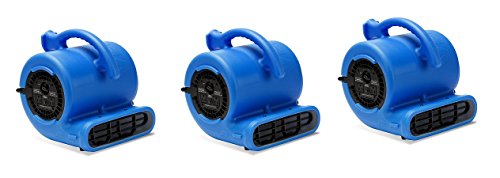
The air mover, represented here by the B-Air VP-25, is a fan that traded room circulation for surface duty. Its CFM-class output exits at a low angle in a focused pattern, which is the geometry that pushes moisture off wet carpet and floor instead of just stirring the air above them. The mover is not faster in the sense of blade speed. It is faster in the sense that its air goes where the water is. The mover's shape is its speed. Air that touches the wet surface is drying air. Everything else is breeze.
The box fan is the honest baseline: cheap, familiar, and built to move air around a room for comfort, not to dry a surface. Its airflow spreads in a wide pattern that feels like a breeze and skims over the wet carpet without the focused, low-angle current that lifts moisture out of the nap. It is the machine you already own, and it is exactly why the upgrade question exists. The box fan circulates. The air mover dries. You can dry a room with a fan. You can dry a carpet with a mover.
A fan in a doorway is a crowd at a concert: everyone moving, nobody going anywhere specific. An air mover is a line of people heading to the exit: all of it moving in one direction, toward one target. The wet surface is the target, and the mover's focused airflow is the line. Circulation feels good. Direction dries the floor.
- Air mover (B-Air VP-25): focused CFM-class airflow at a low angle across the wet surface
- Box fan: wide-pattern room circulation at a fraction of the price
- The test: point both at a wet carpet, and the mover wins because its air touches the nap
The full case for the mover side lives in the B-Air VP-25 review, and the budget answer for when the upgrade is not in the budget yet is the cheapest air mover guide. This page settles the shape question: commercial drying is a surface job, and surface jobs need aimed airflow. The upgrade is not speed. It is aim.
Spec-for-Spec Breakdown
| Spec | Air mover (VP-25) | Box fan |
|---|---|---|
| Airflow pattern | Focused column | Wide circulation |
| Drying angle | Low angle at the surface | Upright room breeze |
| Drying duty | Carpet and floor drying | Room air movement |
| Commercial position | Air mover class | Household fan |
| Price position | Commercial investment | Budget baseline |
The air mover wins every row that matters to drying because its airflow is shaped for the job: a focused, low-angle column across the wet carpet and floor. The box fan wins the price aisle and nothing else on the wet pass. Shape is the spec. The mover has the shape.
Which One Wins (and When)
Choose the air mover when the job is a wet surface: extracted carpet, a mopped floor, a flood pass, or any drying work where the moisture has to leave the nap or the grout. The focused airflow at the low angle is what commercial drying is built on, and the CFM-class output of the VP-25 delivers it in a stackable, fleet-ready frame. The mover wins every job where the water is on a surface. Drying is a geometry problem, and the mover has the geometry.
The honest trade is the price and the use case. An air mover costs more than a box fan, and it is a poor tool for the jobs a fan does well, like cooling a room or venting a garage. Buy the mover for the drying contracts, and keep a fan for the jobs that are not drying jobs. Two tools, two jobs, and the mover earns its keep on the wet ones.
Choose the box fan for the jobs that are actually about the room, not the surface: airing out a space, moving a breeze through a hallway, or the general circulation a fan was built for. At a fraction of the price, the box fan is the honest answer when the budget will not stretch to the commercial mover yet and the work is light. The box fan wins the jobs the mover was never built for. Circulation has its place. It just is not on the wet carpet.
The honest warning is the drying test. If the plan is to dry wet carpet with a box fan, the wide pattern skims the nap and the moisture stays, which is how a two-day drying job becomes a five-day one. When the work is drying, the box fan is the false economy. The upgrade to the mover pays for itself in the hours it saves.
- Your work is carpet and floor drying, where aimed airflow decides the pass
- You want the low-angle focused pattern that touches the wet surface
- You run commercial drying contracts that bill by the hour
- You want a stackable, fleet-ready tool instead of a room fan
- Your job is room circulation and airing out, not surface drying
- The budget will not stretch to a commercial mover yet
- You need a baseline fan for the jobs that are not drying jobs
- You are testing whether the drying route is worth the upgrade
Frequently Asked Questions
Is an air mover worth it over a regular fan?
Why is an air mover better for drying than a box fan?
Can a regular fan dry a wet carpet?
What should a new business buy first, a fan or an air mover?
Reference Standards for This Category
Published standards and programs that buyers in this category are typically accountable to. Listed for context, not as an endorsement of any product on this page.
Related
 Review
 Review
 Review